

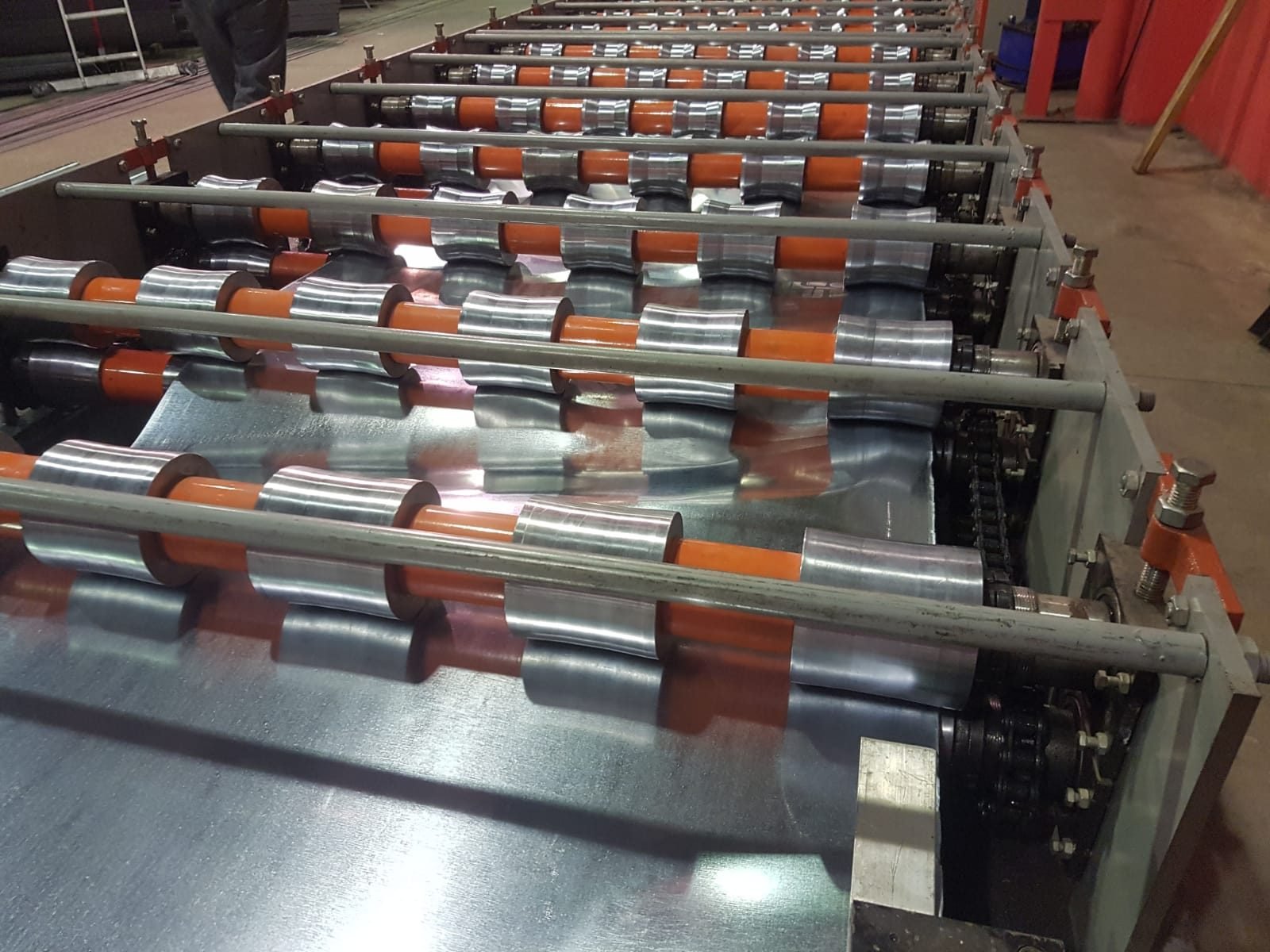
A roll forming machine (also called a roll former) is a continuous production machine that bends coiled sheet metal step by step into the required profile section at room temperature, by passing it through a series of roll stations. Long parts with a constant, repeating section, such as trapezoidal sheet, sandwich panels, cable trays, DIN rails, greenhouse and solar profiles, are mass-produced this way.
How does roll forming work?
Roll forming shapes the sheet not in a single stroke but through many small bending steps. As the strip moves along the line, each pair of upper and lower rolls bends the material a little further than the previous station. When the strip leaves the last station it has the final profile section, and it is then cut to the required length.
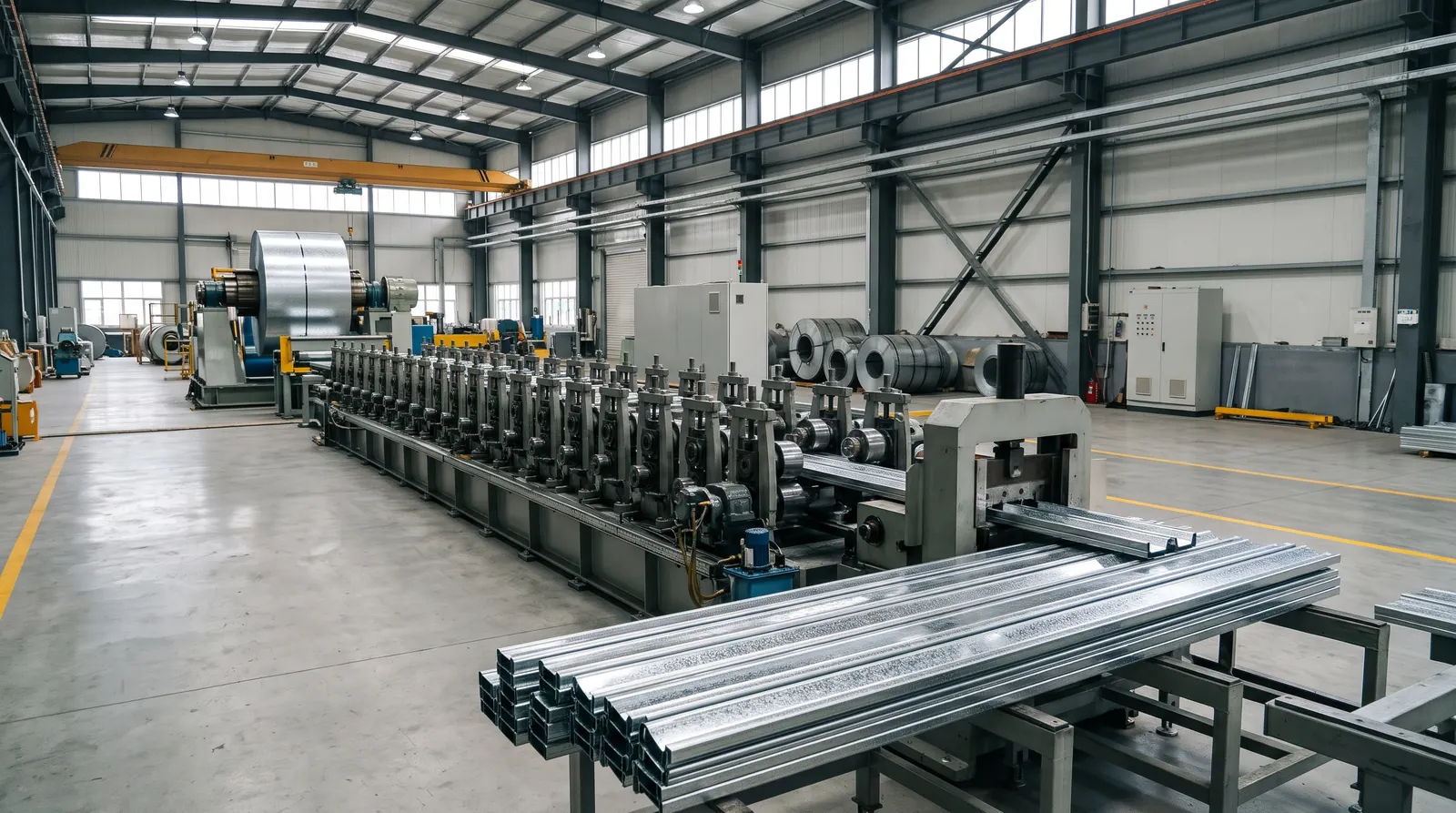
- Continuous production: Because the material moves without stopping, long profiles can be produced in series without interruption.
- Progressive bending: Since the bending work is shared between stations, the material is formed without being overstressed and with consistent dimensions.
- In-line operations: Punching, notching and cut-to-length can be done on the same line.
Components of a roll forming line
A roll forming machine is usually installed not on its own but as part of a line whose units work together. A typical line includes:
- Decoiler: Holds the coil and feeds the strip into the line in a controlled way.
- Straightening and feeding unit: Flattens the strip; servo feeding keeps hole and cut positions accurate.
- Press / punching unit: Punches the holes, slots and notches in the profile. For details, see our Punch Press Roll Forming Machine page.
- Roll forming stations: The main body that bends the profile progressively with roll tooling sets.
- Cutting unit: Cuts the profile to the required length; cutting can be done with the line stopped or while it is running.
- Control system (PLC) and run-out table: Length, quantity and speed settings are managed here; cut parts are collected on the run-out table.
Types of roll forming machines and their applications
Every roll forming line is designed for the profile it will produce. Main examples by industry:
Roofing, cladding and panels
Electrical and infrastructure
- Cable Tray Roll Forming Line
- DIN Rail Roll Forming Line
- Electrical Enclosure Profile Roll Forming Line
Energy and agriculture
- Solar (PV) Mounting C-Profile Roll Forming Line
- Greenhouse Profile Roll Forming Line and Gutter Cut-to-Length
White goods and furniture
- Cabinet V-Support Plate Production Line
- Cabinet Bottom Wheel Plate (Omega) Production Line
- Sliding Door Rail Profile Line
General-purpose profiles
- U-Profile Roll Forming Machine and U/Z Profile Roll Forming Machine
- Heavy-Duty Roll Forming Machine
- Ramp Plate Roll Forming Machine
- Tube Roll Forming Machine
You can browse all our lines by industry on the Products and Services page.
Advantages of roll forming
- Suited to mass production: Profiles with the same section are produced in high volumes without interruption.
- Dimensional consistency: Progressive bending gives a repeatable section from part to part.
- Long parts: Profile length is set to the required size at the cutting unit.
- Fewer secondary operations: When punching, notching and cutting are done on the same line, parts do not have to be moved to separate machines.
- Suitable for coated material: Galvanised and pre-painted sheet can be formed with the surface protected, given the right roll design.
What to consider when choosing a roll forming machine
- Profile section and tolerances: A technical drawing or a sample part is the starting point for the line design.
- Material: Material type (black, galvanised, pre-painted, stainless, etc.), thickness range and strip width.
- Capacity: The daily or annual production target determines the required line speed and level of automation.
- In-line operations: Holes, slots, notches, cut-to-length and stacking requirements.
- Multiple sizes: If more than one size will be produced on the same line, the adjustment and roll changeover method must be planned from the start.
- Floor space and power: Line length, coil storage area and electrical supply.
- Service and warranty: Commissioning, training, spare parts and warranty coverage.
Frequently asked questions
What is the difference between a roll forming machine and a press brake?
A press brake shapes the sheet piece by piece, one bend at a time; it suits short runs and varied parts. A roll forming machine moves the sheet continuously and bends it progressively across many stations; it suits long, high-volume production of profiles with the same section.
Which materials can be processed on a roll forming machine?
Metals supplied in coil form, such as black steel, galvanised steel, pre-painted sheet, aluminium and stainless steel, can be processed. The right line design depends on the material type and thickness.
Can more than one profile be produced on a roll forming line?
Yes, if the line is designed for it. Adjustable stations or interchangeable roll tooling sets are used. This requirement should be stated at the quotation stage.
What determines the price of a roll forming machine?
The price depends on the complexity of the profile section, the number of stations, material thickness, line speed, the press and cutting units on the line and the level of automation. For an exact price, request a quote with your profile drawing and capacity information.
Plan your roll forming line with Enerji Makina
Enerji Makina designs and builds custom roll forming machines and production lines at its plant in Nazilli, Türkiye. With more than 20 years of experience, we have completed 186 projects in the last 5 years; our machines come with a 3-year warranty and are in use in 25 countries.
Share your profile drawing or sample and let’s plan your line together: contact us or call +90 544 236 43 49.